
Home › Korean gelatin for skin
Korean Gelatin for Skin: What the Label and the Studies Really Say
Korean gelatin for skin is a phrase to check before you trust it, and I found no official definition in my sources. Gelatin comes from collagen, but the reviews I cite studied collagen supplements and disagree on how strong that evidence is. Always look for the ingredient on the actual label.
 By Tara Whitcomb · Updated November 2026
This site may earn a commission if you buy through links on the review page. It does not change what we recommend. How this works
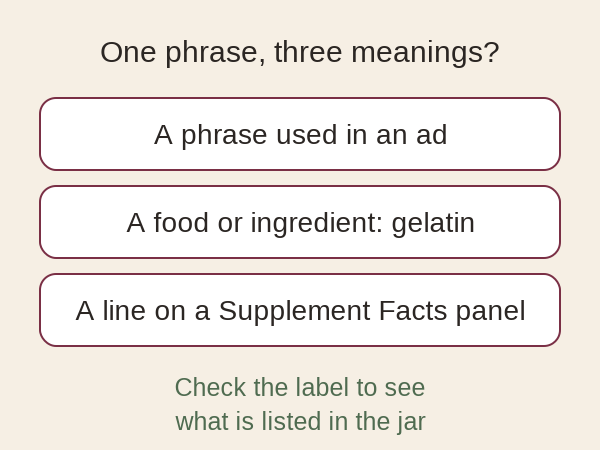
Korean gelatin is what got me curious. My first instinct was to believe whatever sounded nicest, and my second one was to slow down and look things up. This page is that homework.
I'm not a medical professional. I also won't hand you a recipe or tell you what your skin will do. We'll separate the phrase, the ingredient, the research and the label.
What is Korean gelatin?
"Korean gelatin" is a search phrase that raises a simple question about what it means. In the sources opened for this page, I did not find an official definition of it. So treat it as a name to investigate, not as a known ingredient with a set formula.
When a name is fuzzy, ask what it points to. It might mean a food, a powder, a recipe, a supplement ingredient or just a style of ad. Two pages can use the same words and mean different things.
Before you compare anything, look for three facts: what the substance is, what animal or other source it comes from and how much is in one serving. If a page can't tell you, the phrase isn't doing much work for you.
Is gelatin the same thing as collagen?
They are related, but they aren't the same item. A definition quoted on an FDA export page describes gelatin as a natural, soluble protein obtained by the partial hydrolysis of collagen. In plain words, it is made by partly breaking collagen down.
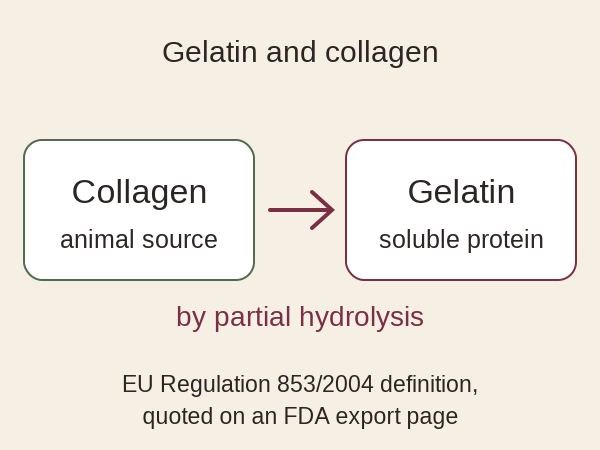
The FDA page on collagen and gelatin export lists quotes a European Union regulation. That page also names animal parts such as bones, hides, skins and tendons as sources of the collagen. It is a trade definition, not a statement about skin benefits.
You may also see "hydrolyzed collagen" and "collagen peptides" on supplement labels and in studies. Don't swap those names for gelatin without checking. A result for one ingredient doesn't automatically carry over to another.
The animal source matters too. If you avoid certain animal products for allergy, diet or faith reasons, find out the exact source before you eat or swallow anything with gelatin or collagen.
Does eating gelatin help your skin?
I can't tell you that it does. The reviews used for this page looked at collagen supplements, not a Korean gelatin product or recipe. The limited search done for this page did not turn up a study that answers the gelatin question, and that doesn't prove no study exists.
It's tempting to connect the dots: skin has collagen, gelatin comes from collagen, so eating gelatin must help skin. That chain sounds tidy, but each link would need evidence. A trial has to test what happens in people, with a stated ingredient, amount and time period.
For any gelatin claim you meet, ask to see that trial. A before-and-after picture isn't the same thing. You may not know the lighting, the other products used or what happened to everyone else.
What do collagen studies say?
The reviews don't tell one simple story. An updated 2026 review reported gains in skin hydration, elasticity and barrier function with oral collagen peptides. A 2025 review found no significant effect in its high-quality trials and concluded there is no clinical evidence to support collagen supplements for skin aging.
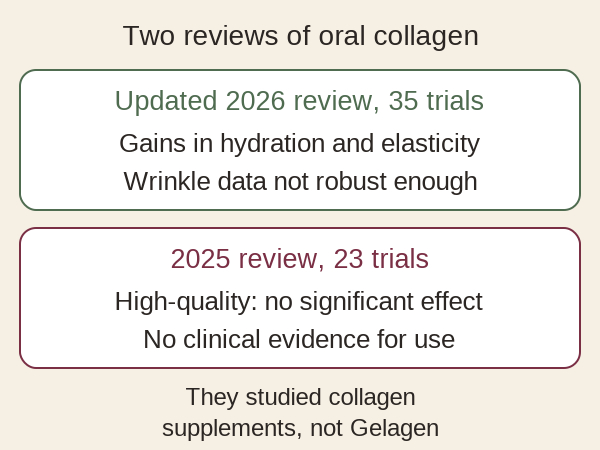
The updated 2026 meta-analysis pooled 35 randomized trials with 2,534 participants. In that analysis, the elasticity and barrier gains needed at least 12 weeks. For wrinkles and skin density, the authors said the data were not robust enough for definitive conclusions.
The 2025 review by Myung and Park included 23 trials with 1,474 participants. All trials pooled together showed improvements in hydration, elasticity and wrinkles. But the picture changed when the authors sorted them.
Trials without pharmaceutical funding showed no benefit, while funded ones did. High-quality trials showed no significant effect, while low-quality trials showed better elasticity. Their conclusion was direct: there is currently no clinical evidence to support using collagen supplements to prevent or treat skin aging.
A meta-analysis depends on the trials inside it. When two reviews disagree, I don't pick the one with the happier headline. I say the question is still debated.
And again, these reviews studied collagen supplements. I won't use them as proof for gelatin, for a recipe or for a gummy that doesn't list collagen.
Does Gelagen contain Korean gelatin?
The official Gelagen label, as read in November 2026, does not list gelatin or collagen, either in Supplement Facts or in Other Ingredients. The words "Korean Technology" are printed on the front, but they are not an ingredient listed in the panel.
If gelatin is the reason you're interested, don't assume it is in the jar. Ask the seller to show you a current label that lists it, and get the answer in writing before ordering.
What the official label does list is a mix of vitamins, iodine, zinc and inositol. Its Other Ingredients are corn syrup, water, pure cane sugar, pectin, citric acid, natural flavor, sodium citrate, tapioca starch and beet root extract for color. My skin gummy ingredients guide walks through the panel.
One line stands out for lab work: biotin, at 5,000 mcg per serving. Please read biotin and blood tests if you have testing ahead.
How can you check a gelatin or collagen claim?
Match the words in the ad to the words on a current label. Find the ingredient name, its source and its amount per serving. Then check whether the study being cited used that same ingredient in people, and whether you can open the study yourself.
- Name: is gelatin, collagen or collagen peptides written in the panel or ingredient line?
- Amount: how much is in one serving?
- Source: which animal or other source is stated?
- Study: does it test this product or the same ingredient and amount?
- Page: are you on the address you meant to visit, and does the jar shown match the label?
Save screenshots with the date. Sales pages can change, and your own record will help if you need to ask about what you saw.
Who should ask a doctor before trying a gelatin or skin supplement?
Anyone who wants to try one can start by showing the current label to a clinician. That step matters most if you take medication, have a medical condition or allergy, or are pregnant or nursing. The ingredient list helps decide which questions to ask.
Who should not take it without medical advice
For Gelagen, the label says people under a physician's care or taking medication should consult a healthcare professional first. People who are pregnant, nursing or have a known medical condition should not use it without consulting a physician.
Possible side effects
I won't guess side effects for a product or recipe I can't identify. For Gelagen, I did not see a side effect list on the official label, which is not proof that none can happen. Its listed nutrients, such as vitamin A and iodine, deserve a total count with your other supplements.
Talk to your doctor if...
- You have a food allergy and can't confirm a product's source.
- You have a thyroid condition, diabetes or any other ongoing health concern.
- You have blood work coming up and the product contains biotin.
- A skin change is new, painful, spreading or worrying you.
Get emergency care right away for trouble breathing or swelling of the face or throat.
If a hard moment with the mirror sent you searching, I get it. You deserve clear words, not pressure. Here's why this site exists and how it works.
Came here curious about gelatin?
The official Gelagen label doesn't list gelatin. See the Gelagen review before you decide anything.
Read the full reviewFrequently asked questions
Is Korean gelatin a specific ingredient?
I did not find an official definition in the sources opened for this page. Ask what substance, source and amount a page means.
Is gelatin the same as collagen?
No. Gelatin is a protein obtained by partly breaking down collagen. They are related but named separately.
Are collagen studies proof that gelatin works?
No. The reviews on this page studied collagen supplements, so they should not be treated as proof for gelatin.
Does the Gelagen label list gelatin?
The official label, as read in November 2026, does not list gelatin or collagen in the panel or in Other Ingredients.
Is Korean Technology an ingredient in Gelagen?
No ingredient by that name appears in the official label. It is a phrase printed on the front of the label.
Is this page a gelatin recipe?
No. It explains the phrase, the ingredient, the research and how to check a label.

Tara Whitcomb
I'm Tara, 36, from Boise. Korean gelatin made me curious, so I started checking labels, ingredients and studies before believing anything.
I'm not a medical professional. Talk to your doctor before changing your routine or starting a supplement. About Tara and this site
These statements have not been evaluated by the Food and Drug Administration. This content is for information only and is not medical advice. Results may vary. Talk to your doctor before starting any supplement, especially if you take medication.