
Home › Skin gummies ingredients
Skin Gummies Ingredients: How to Read the Label Before You Buy
To check skin gummies ingredients, read the Supplement Facts panel and the Other Ingredients line. Look at serving size, each amount, percent Daily Value, added sugar and caution text. Then check that the page you order from matches that label, because the front of a jar can't tell the whole story.
 By Tara Whitcomb · Updated November 2026
This site may earn a commission if you buy through links on the review page. It does not change what we recommend. How this works
Hi, I'm Tara. I'm not a medical professional. I'm the friend who turns the jar around before getting excited about the front of it. This guide is the homework I'd hand you over coffee: what to read, in what order, and which questions the label simply can't answer.
I use one real label as the worked example: the official Gelagen label published on the seller's home page, as read in November 2026. Brands can change labels, so check the jar or page in front of you.
What should you look at first on a skin gummy label?
Start with the Supplement Facts panel and the Other Ingredients line, not the front of the jar. The panel shows the serving size and the listed nutrients with their amounts. The line below shows what else goes into the gummy.
The front is built to catch your eye. It may show a glow, a drop of water or a phrase about technology. Those can be nice to look at, but they don't tell you how much of anything is inside.
On the Gelagen label, for example, the front says "Korean Technology" and "Advanced Gummies for Skin Health." The first phrase is printed branding. It isn't an ingredient name, and it doesn't appear as a line in the panel.
Here's my simple order:
- Serving size and servings per container.
- Each nutrient, its form, its amount and its percent Daily Value.
- Calories and sugar.
- Other Ingredients.
- Suggested use, caution text and who distributes the product.
How do you read serving size and percent Daily Value?
Every amount in the panel belongs to one serving, so read the serving size first. The percent Daily Value column then compares each listed amount with a daily reference.
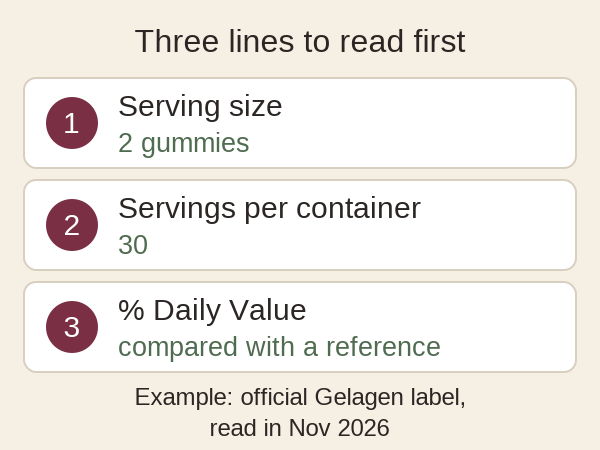
The Gelagen label lists a serving of 2 gummies and 30 servings per container. It also shows 60 gummies on the front, so the math matches. Its suggested use says adults take two gummies daily, or as directed by a healthcare professional.
It also says to take them about 30 minutes before your morning or afternoon meal with a full glass of water. That's the label's wording for use. It isn't a promise about what happens next.
A high percentage is not automatically good or bad. It shows how the amount in one serving compares with the reference. On this label, the column runs from 0% for choline to 16,667% for biotin, so one quick look down it shows very different sizes.
Read the amount and the unit along with the percentage. This panel uses mcg, which means micrograms, and mg, which means milligrams. Some lines look small as numbers but are written in different units, so don't compare two digits without checking the letters next to them.
A dagger next to an item means no Daily Value has been established for it. On this label, you'll see it next to total sugar and inositol.
What is listed in the Gelagen Supplement Facts panel?
The official Gelagen label lists vitamins A, C, D, E, B6 and B12, folate, biotin, pantothenic acid, choline, iodine, zinc and inositol. One serving of two gummies also has 10 calories, 10 mg of sodium and 3 g of added sugar.
| Listed on the label | Amount | % Daily Value |
|---|---|---|
| Calories | 10 | |
| Total Carbohydrate | 3 g | 1% |
| Total Sugar | 3 g | Not established |
| Includes 3 g Added Sugars | 6% | |
| Sodium | 10 mg | <1% |
| Vitamin A (as retinyl acetate) | 630 mcg | 70% |
| Vitamin C (as ascorbic acid) | 20 mg | 22% |
| Vitamin D (as cholecalciferol) | 10 mcg | 50% |
| Vitamin E (as d-alpha tocopheryl acetate) | 7.4 mg | 49% |
| Vitamin B6 (as pyridoxine hydrochloride) | 2 mg | 118% |
| Folate (260 mcg folic acid) | 442 mcg DFE | 111% |
| Vitamin B12 (as methylcobalamin) | 6 mcg | 250% |
| Biotin | 5,000 mcg | 16,667% |
| Pantothenic acid (as d-calcium pantothenate) | 5.2 mg | 104% |
| Choline (as choline bitartrate) | 0.04 mg | 0% |
| Iodine (as potassium iodide) | 42 mcg | 28% |
| Zinc (as zinc citrate) | 2.7 mg | 25% |
| Inositol | 40 mcg | Not established |
Two lines show why reading matters. Biotin sits at 16,667% of the Daily Value. Choline is on the list too, but the label shows 0.04 mg as 0%. A name on a panel tells you it is declared. The amount tells you how much.
The words in parentheses are the form of the nutrient. Retinyl acetate, for example, is a form of preformed vitamin A, according to MedlinePlus on vitamin A. That detail matters in the safety section below.
The same habit works down the whole list. This label writes vitamin D as cholecalciferol, vitamin B12 as methylcobalamin, iodine as potassium iodide and zinc as zinc citrate.
When you compare two products, copy the name, the form, the amount and the unit for each line.
The folate line also has a second number in parentheses: 260 mcg of folic acid, next to 442 mcg DFE.
Does a nutrient on the label prove a skin result?
No, a line in the panel tells you what is declared and how much. A visible skin result is a separate claim that needs its own evidence.
The idea is easy to blur. "This nutrient is in the gummy" is one statement. "This product will change how your skin looks" is a much bigger one, and the panel doesn't make that second statement for you.
The label helps you keep the two apart. The Supplement Facts panel lists names, amounts and percentages. It has no line for glow, hydration or smoothness, and no line that says how fast anything happens.
The Gelagen front uses the phrases "Youthful Glow," "Deep Hydration" and "Smooth Appearance," each with an asterisk.
The label also prints an asterisked statement: these statements have not been evaluated by the Food and Drug Administration, and the product is not intended to diagnose, treat, cure, or prevent any disease.
So read the front phrases as the brand's own wording, and read the panel for the facts you can compare. For the biotin line and why it matters before testing, see my biotin and blood tests guide.
Who is Gelagen for, and does it list collagen or gelatin?
Gelagen is a gummy with vitamins, iodine, zinc and inositol, and pectin appears among its other ingredients. It can make sense if you want that kind of routine in gummy form. The official label does not list collagen or gelatin.
The appeal of the format is easy to picture: a serving is two gummies, and each jar has 30 servings. The panel gives an amount for every vitamin and mineral it lists, plus inositol, so you can compare it with what you already take before you decide.
The full Other Ingredients line reads: corn syrup, water, pure cane sugar, pectin, citric acid, natural flavor, sodium citrate, tapioca starch and beet root extract for color. So if collagen is what you're shopping for, this label doesn't show it. If this mix of listed nutrients is what you want, you know what to check next.
Curious about Korean gelatin? I untangle the phrase, the ingredient and the research in Korean gelatin for skin.
Does a vitamin gummy like this fit what you're looking for? Read the full Gelagen review before you decide.
What should you check before ordering Gelagen?
Start with what the official label gives you: a 2-gummy serving, 30 servings per container and a listed amount for each vitamin and mineral, plus inositol. With those facts in hand, you can check the page you order from with confidence.
A few amounts per serving to check first: 630 mcg of vitamin A, 20 mg of vitamin C, 5,000 mcg of biotin, 42 mcg of iodine and 2.7 mg of zinc. The full panel table has every line. Show it to your pharmacist or doctor if you already take other supplements.
Next, match the jar. It should carry the Gelagen name, the words "Advanced Gummies for Skin Health," a count of 60 gummies and the same Supplement Facts panel you've just read.
If everything lines up, you're deciding with the facts in front of you. If something differs, pause and ask the seller in writing before ordering.
Checked the label and want the next step? Read the full Gelagen review before you order.
How much sugar is in a serving?
One 2-gummy serving of Gelagen lists 3 g of total sugar, and the label shows all 3 g as added sugars. It puts that amount at 6% of the Daily Value.
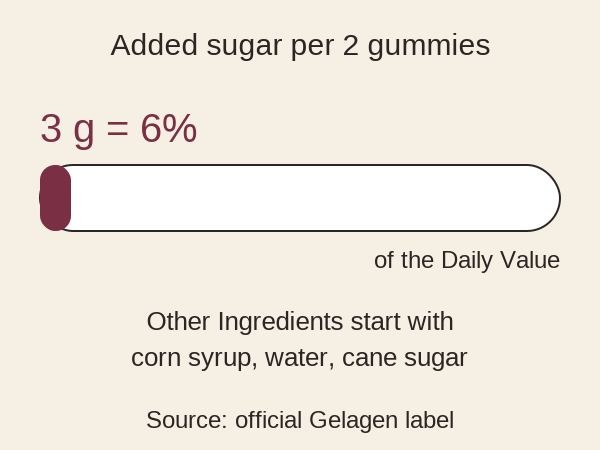
The same panel shows 3 g of total carbohydrate at 1% of the Daily Value, along with 10 calories and 10 mg of sodium, which is listed as less than 1%. All of these are per two gummies, so they change if the number you take changes.
Look at the Other Ingredients line too. It starts with corn syrup, then water and pure cane sugar. If you compare two gummies, put the added sugar line and the serving size side by side, because one label's serving may not match another's.
If you have diabetes or you track carbohydrates for any reason, bring the panel to your care team. They can tell you how a daily gummy fits your plan.
What else does the label tell you before you open the jar?
Outside the panel, the Gelagen label covers storage, the safety seal, children, where the product was made and who distributes it. These lines are short, and they're worth reading before the first serving.
The storage line says to keep the product in a cool, dry place. It also says to keep it out of the reach of children. Pick a spot that meets both, and don't treat the gummies like a bowl of candy on the counter.
The label says not to use the product if the safety seal is damaged or missing. Check the seal when the package arrives, before you open anything. If it looks wrong, take a clear photo, keep the packaging and contact the seller about your order.
You'll also see "Made in the USA with globally sourced ingredients." Read the whole sentence. It speaks about where the product is made and says the ingredients come from sources around the world. It doesn't name a country for each ingredient.
The suggested use is written for adults and leaves room for a healthcare professional to direct something else. If your doctor or pharmacist gives you different advice after seeing the panel, follow that conversation instead of a habit you picked up from an ad.
Last, find the distributor block. It tells you which company the label names, with a city and contact details. Keep a photo of that block with your order confirmation, so you have it if you ever need to ask a product question.
Who should talk to a doctor before taking a skin gummy?
The Gelagen label gives a clear starting point. People under a physician's care or taking medication should consult a healthcare professional first. If you are pregnant or nursing, or have a known medical condition, it says not to use it without consulting a physician.
Who should not take it without medical advice
- Anyone pregnant or nursing. MedlinePlus says large doses of vitamin A during pregnancy can cause birth defects. Ask your doctor to add up every source, including your prenatal vitamin.
- Anyone with a thyroid condition. The label lists iodine. The MedlinePlus iodine page says very high iodine intake can reduce thyroid function, and high doses taken with anti-thyroid medicines can add to their effect.
- Anyone taking medication, under a doctor's care or living with a known condition, as the label itself says.
The label also says to keep the product out of the reach of children, and its suggested use is written for adults.
Possible side effects: what can and can't be said
The official label has a caution paragraph, but I did not see a list of side effects on it. That is not proof that there are none.
What I can point to is general information about vitamin A, one of the listed nutrients. MedlinePlus says that getting more vitamin A than you need can build up in the body and cause serious health problems.
That statement is about excess intake, not about this serving. The useful step is to add up your gummies, multivitamin and other supplements, then show the total to a pharmacist or doctor.
Talk to your doctor if...
- You have a blood test coming up. This serving lists 5,000 mcg of biotin, so tell your doctor and the lab, and read the biotin and blood tests guide, which links its sources.
- You already take a multivitamin or any product with vitamin A, iodine or biotin.
- You have diabetes, a thyroid problem, a food allergy or surgery on the calendar.
- You notice anything new or unwelcome after starting any supplement.
Get emergency care right away for trouble breathing, swelling of the face or throat, chest pain, fainting or any other severe symptom.
How can you check a supplement claim?
Ask what exactly was studied: the finished product, one ingredient or a different ingredient altogether. Then look at the amount used and how the result was measured. Remember that the FDA does not approve dietary supplements for safety and effectiveness before they are sold.
The official Gelagen label also says the product was manufactured in an FDA registered facility. That line is about the facility. It doesn't mean the FDA approved the gummy. The FDA consumer page on supplements also suggests talking to a doctor, pharmacist or other healthcare professional.
Try these five questions on any page:
- Does the study name this product, or only an ingredient?
- Is that ingredient listed on the label at all?
- Is the studied amount similar to the amount in one serving?
- Was it a trial in people, compared against a placebo?
- Can you open the source yourself?
When a page mentions research but shows no study you can open, I treat the question as unanswered. I also skip star ratings that don't explain how they were built.
How do you know which website and jar you're looking at?
Compare the label with the page you're on before you enter payment details. The label example in this guide came from the seller's home page. A matching product name alone doesn't show that two pages carry the same offer.
Check that the jar shown on the page matches the label you've read: the name, the gummy count and the Supplement Facts panel. If something differs, pause and ask the seller in writing before ordering.
Match the jar to the panel. The official label shows 60 gummies and names Instituto Experience in Lakeland, Florida, as the distributor. For questions about the product, use the distributor contact printed on your own jar. This blog is not the distributor.
Before you pay, take a screenshot of the price, the shipping line and any guarantee wording. Read the seller's current terms on its own pages, and save your order confirmation.
What is a calm way to decide?
Write down what you want from the product, then check whether the label shows it. If you want a gummy format with these listed nutrients, you now know what to compare. If collagen is what you want, remember that this label doesn't list it.
There's no rush. A photo of the panel is quick and gives your pharmacist something real to look at. It also gives you something to compare if the label changes.
When you've done your label homework, the product review is the next stop. And if you want to know who is behind these pages, here is how this site works.
Done with the label homework?
The Gelagen review is the next step if this is the jar you're considering.
Read the full reviewFrequently asked questions
What is the most important part of a skin gummy label?
The Supplement Facts panel, together with the Other Ingredients line. Start with the serving size, then read each amount.
Does the official Gelagen label list collagen?
No. Collagen does not appear in its Supplement Facts panel or in its Other Ingredients line.
How many gummies are in one serving of Gelagen?
The label lists two gummies per serving and 30 servings per container.
Is Gelagen FDA approved?
The FDA does not approve dietary supplements for safety and effectiveness before they are sold. A registered facility line is not product approval.
Can I take a skin gummy with my multivitamin?
Ask a pharmacist or doctor first. Bring both labels so they can add up vitamin A, iodine, biotin, zinc and the other nutrients.
Can a skin gummy affect lab tests?
It can matter if the gummy lists biotin, so tell your doctor and the lab before testing. The biotin and blood tests guide on this site explains why and links its sources.

Tara Whitcomb
I'm Tara, 36, from Boise. Korean gelatin made me curious, so I started checking labels, ingredients and studies before believing anything.
I'm not a medical professional. Talk to your doctor before changing your routine or starting a supplement. About Tara and this site
These statements have not been evaluated by the Food and Drug Administration. This content is for information only and is not medical advice. Results may vary. Talk to your doctor before starting any supplement, especially if you take medication.